Dream11 (India's largest fantasy sports platform with 250M+ users) processes millions of payment transactions in the minutes before match start times. During peak events like the IPL (Indian Premier League, India's biggest cricket tournament), even small friction points in the deposit, withdrawal, or verification flow translated directly into lost revenue and flooded support queues. At the same time, new government regulations around real-money gaming required Dream11 to introduce responsible play features that protected users without making compliance feel like punishment.
Payments at Dream11's scale demand more than working infrastructure. They demand an experience users can trust in real time, especially when real money is involved.
Across three years in the payments team, I worked across the UI, motion, and interaction layer: introducing health check indicators so users could see payment gateway status before attempting a transaction, redesigning the verification flow to surface all options upfront with localised copy for non-metro audiences, building Responsible Play features that met regulatory requirements while preserving user dignity, and adding micro-interactions and animations across every payment touchpoint that transformed mechanical flows into moments of delight.
Senior Product Designer at Dream11 (2021 to 2023). I was part of a 3-person design team working with the payments squad: a Lead UX Designer, myself as Senior Product Designer, and a Junior UX Designer, all overseen by a Director-level designer. Within that team, I owned UI, motion design, interaction design, and illustration direction across all payment, verification, and compliance surfaces. The verification redesign, localisation push, Responsible Play screens, and all micro-interactions and animation direction were work I personally led. Product and infrastructure teams drove feature strategy; I owned how every feature felt to the user.
Dream11 sees its sharpest traffic spikes in the 30 minutes before a match starts. Users deposit, join contests, and withdraw winnings in rapid succession during these windows. At that scale, a confusing error state or a failed payment with no explanation does not frustrate one user. It generates thousands of support tickets in minutes.
The payment screens at the time were functional but bare: static, generic, and offering no reassurance at moments involving real money. Verification screens used abstract compliance graphics that felt foreign to Tier 2-3 users in smaller Indian cities, many of whom were completing a KYC (Know Your Customer, identity verification) flow for the first time. And in 2023, the Indian government introduced new regulations requiring real-money gaming platforms to implement responsible play features, giving users tools to set deposit limits, loss alerts, and play breaks.
The brief across this period was consistent: scale payments without breaking them, make compliance feel like something the platform built for users rather than something imposed on them, and bring craft and delight to flows that had none.
The clearest signals came from two sources: support ticket data and benchmarking across other consumer payment experiences.
Support ticket data showed two consistent pain points. First, verification rejections were generating a high volume of confused inbound queries because users who got rejected had no useful next step on screen. Second, payment failures during peak windows were frequently caused by users selecting a payment method without any visibility into which ones were performing well at that moment.
The team also did extensive benchmarking across Swiggy and Zomato's payment flows. Both apps had already normalised real-time payment status signals, one-tap checkout for repeat users, and instant retry flows for failed transactions. These were established patterns in Indian consumer apps. Our work was to identify which applied to Dream11's payment context and adapt them for our scale and user base.
For the verification screen specifically, I drew on CX team observations about Tier 2-3 user behaviour. The pattern was consistent: abstract compliance graphics communicated very little to users completing a KYC flow for the first time. Player imagery connected immediately. Users recognised Hardik Pandya and associated the screen with a platform they already trusted, rather than a compliance form from an unfamiliar source.
Health check indicators were already an established pattern when we introduced them at Dream11. Swiggy and Zomato had normalised real-time payment status signals in their flows. The payments team, product and design working together, identified this as a clear gap in Dream11's experience and adapted the pattern for our context.
The implementation surfaced live gateway status next to each payment method before the user attempted a transaction. A label like "Transaction might fail" gave users the information to choose a better option rather than discovering a failure after the fact. Alongside this, we introduced payment personalisation: the system recommended the highest-success payment method dynamically based on the user's payment history and live gateway performance data.
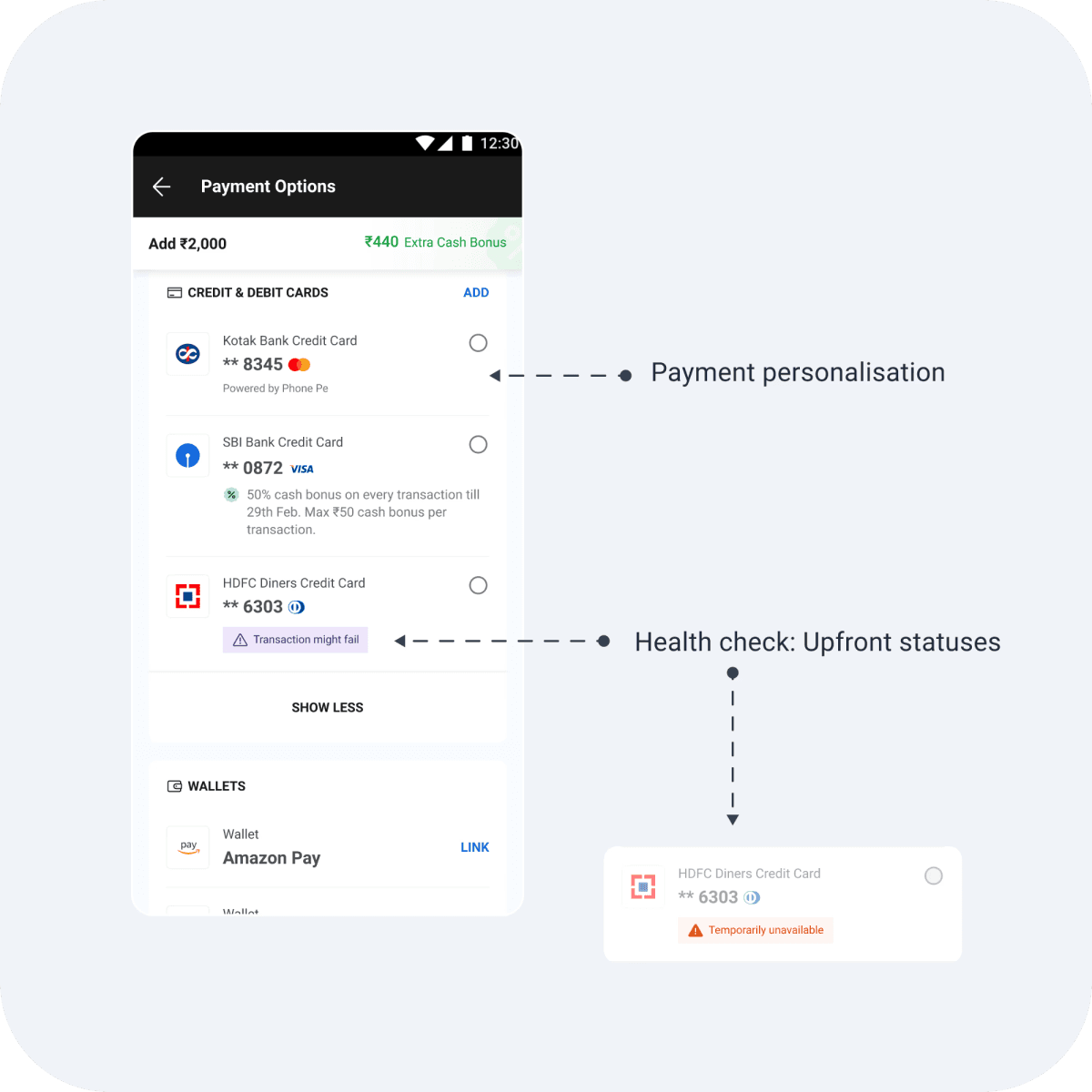
Both features addressed the same underlying anxiety: users had no visibility into whether their transaction was likely to succeed before they committed to it. The design gave them that visibility without requiring them to understand anything technical about gateway infrastructure.
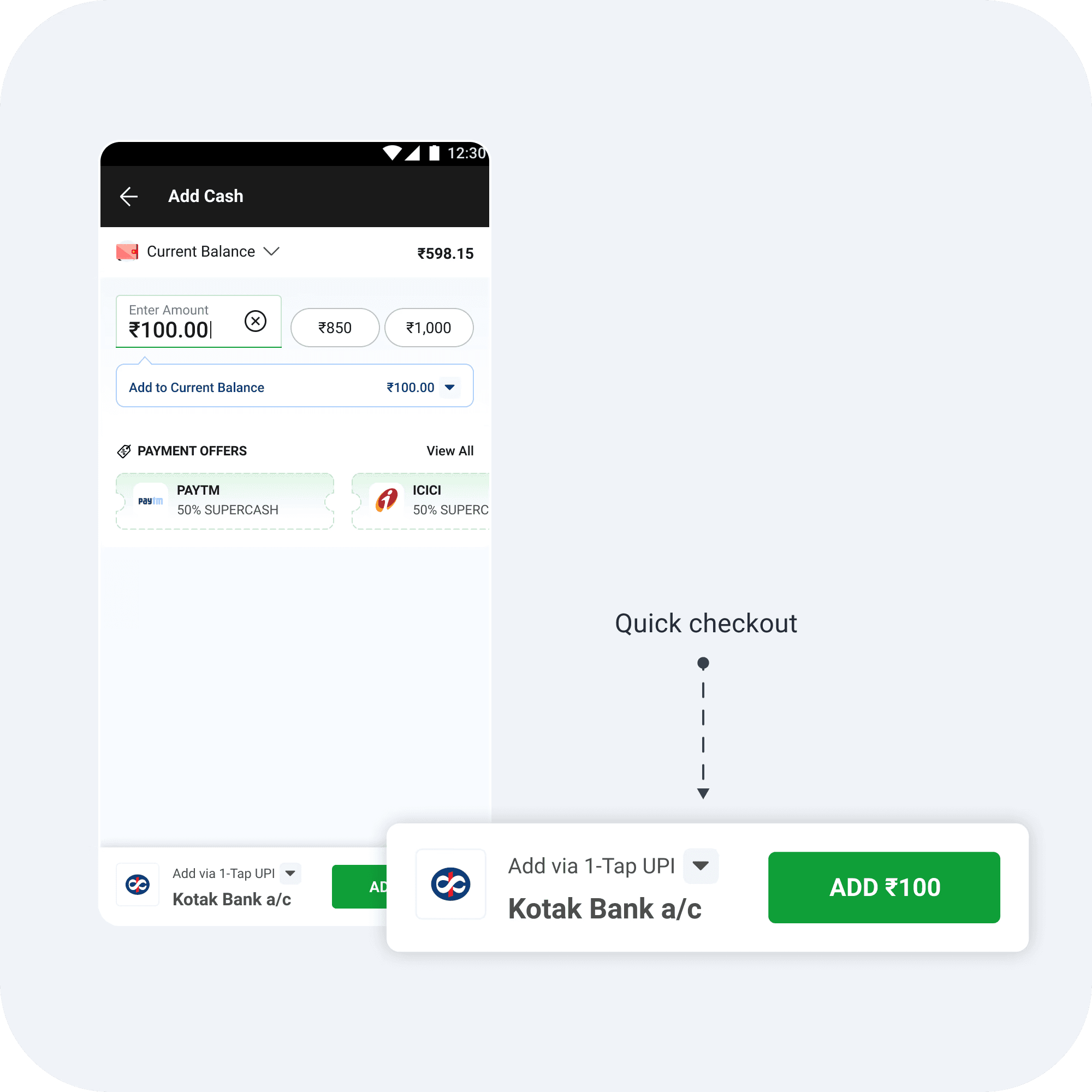
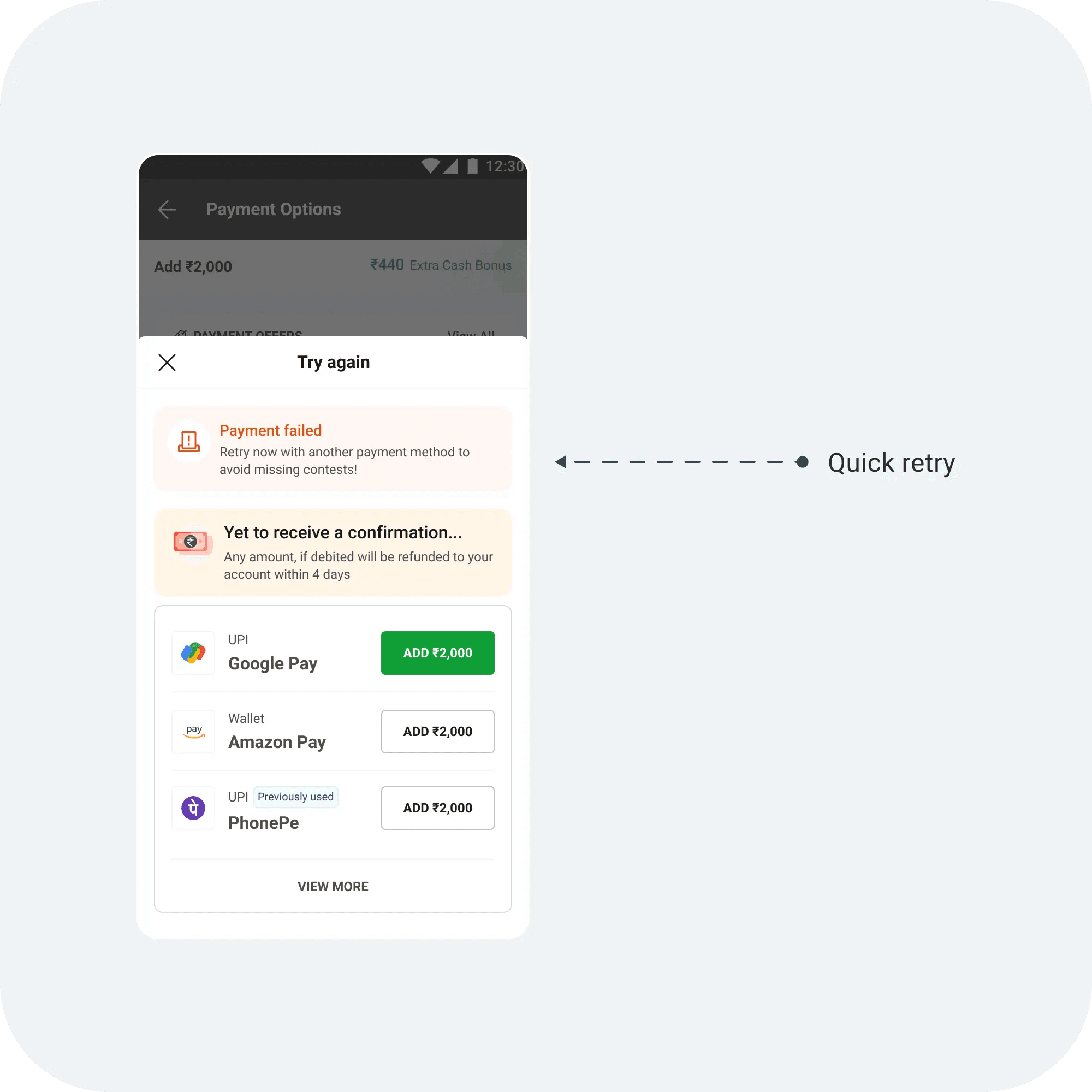
Repeat users on Dream11 go through the same deposit flow multiple times across a single match day. Every additional tap in that flow is friction compounded across millions of sessions.
Quick Checkout collapsed the repeat deposit flow to a single tap for users who had already saved a preferred payment method. The design recognised returning intent and removed every unnecessary step between that intent and completion.
Quick Retry addressed the failure recovery moment: instead of forcing users who hit a failed transaction to re-enter all their details and start over, the retry flow reinstated everything with one tap and surfaced the reason for the failure clearly.
Both features were inspired by benchmarking from Swiggy's checkout flows, adapted for the specific context of a real-money gaming deposit at match-start time, where urgency is high and tolerance for friction is near zero.
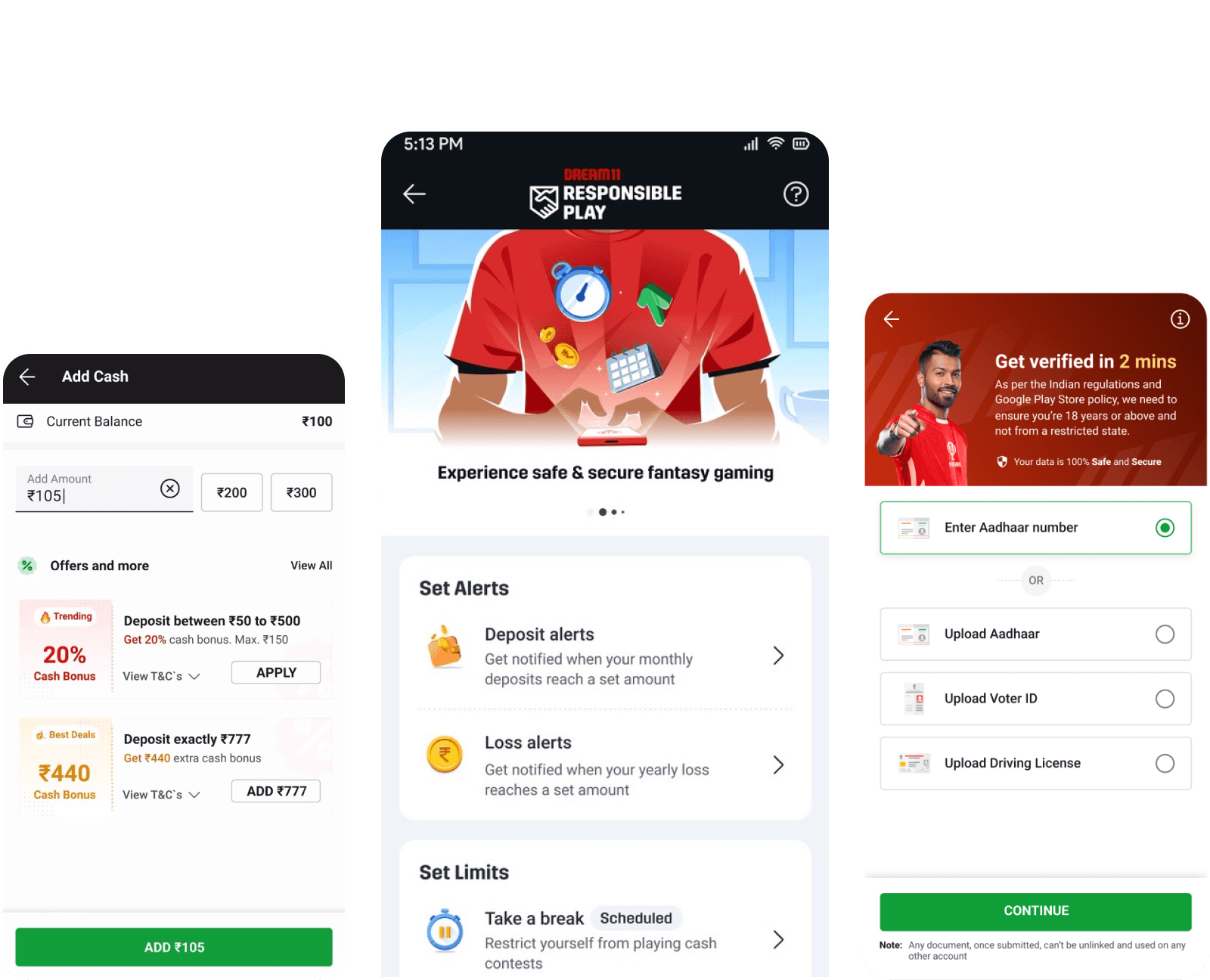
The old verification screen opened with a conditional question before users could begin: "Is your mobile linked with Aadhaar?" Users in Tier 2-3 cities frequently did not know the answer. Many dropped off before the flow had even started.
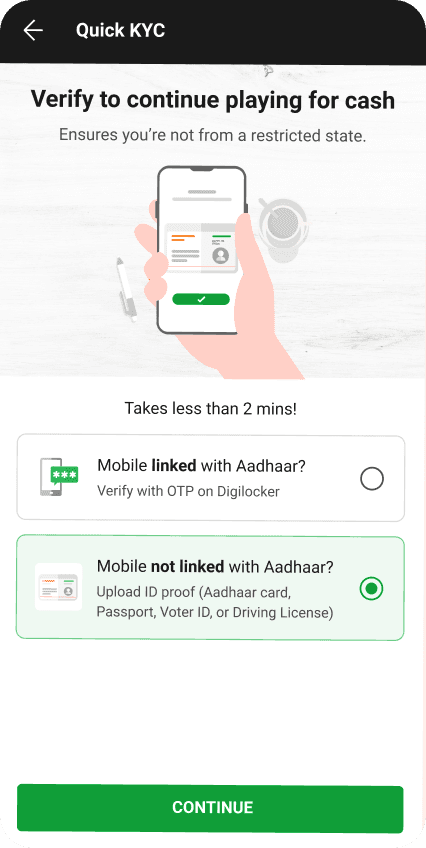
I redesigned the screen to remove the conditional logic entirely. All verification options appeared upfront: Enter Aadhaar number, Upload Aadhaar, Upload Voter ID, Upload Driving License. Users could immediately see which path applied to them without having to self-diagnose first.
Two other changes I drove on this screen:
The hero image: The previous version used a generic graphic of a phone with an Aadhaar card illustration. I proposed replacing it with a Dream11 player image (Hardik Pandya), drawing on consistent CX team observations that Tier 2-3 audiences responded significantly better to player imagery than to abstract UI graphics. The player image signalled trust and platform familiarity at a moment when users were being asked to hand over sensitive identity documents.
Localisation: I pushed the product team to introduce Hindi and Kannada versions of the verification screen copy for non-metro users. "Get verified in 2 mins" in a user's own language reads as an invitation. The same line in English reads as an instruction. For a user in a smaller city completing KYC for the first time, that difference mattered.
The revamp included product changes too, including the introduction of the Aadhaar Lite flow.
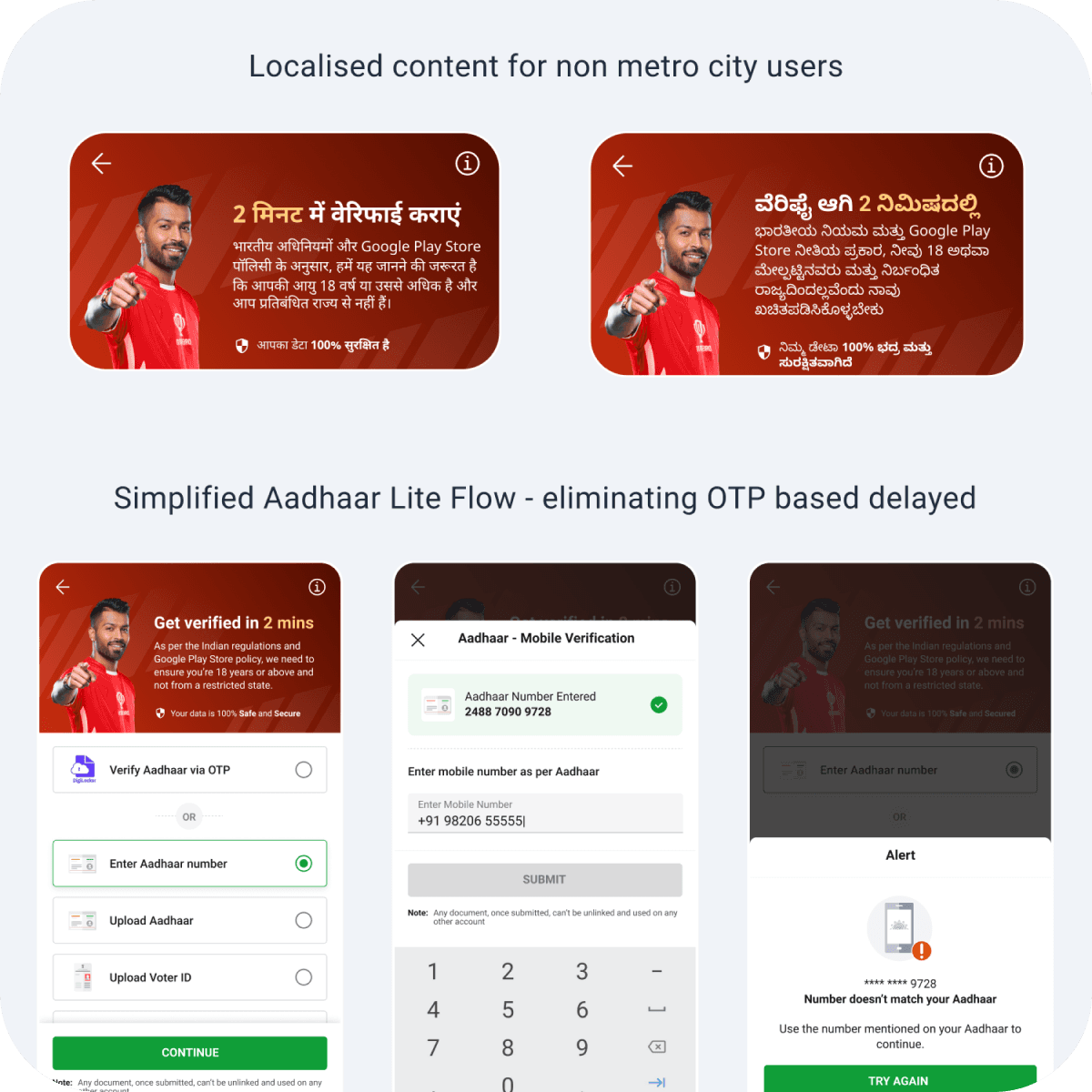
The full combination of design and product changes moved these numbers: 14.26% increase in Play Store new users and 1.57% increase in paid contest joins. At Dream11's scale of 250M+ users, a 1.57% PCJ lift represents millions of additional contest entries. Verification completion time dropped to under 1 minute.
Deposit offers were a product-led initiative: time-bound cash bonuses tied to specific deposit amounts, designed to encourage users to add funds at optimal moments. Other real-money gaming apps in India like My11Circle were already running similar mechanics, but their presentation was minimal: a single line of text stating the deposit amount and the bonus received.
I designed Dream11's offers UI to be more structured and scannable: clear bonus percentages, countdown timers to create urgency, and a hierarchy that let users quickly identify the best deal for their deposit amount. When the design went through legal and compliance review, we were required to display all terms and conditions upfront on the card itself, including usage limits, valid days, bank restrictions, and expiry. That requirement made the cards larger and more text-heavy than the original design. The cleaner version did not survive compliance review. What shipped was the best possible execution within those legal constraints.
The offers section drove a 226% increase in engagement and a 5% uplift in new paid contest joins. The honest context: deposit offer mechanics perform strongly with Indian consumers by default. The design made the offers visible, clear, and easy to act on. Both the mechanic and the design contributed to those numbers
In 2023, the Indian government introduced regulations requiring real-money gaming platforms to give users active tools to manage their own play behaviour. Dream11's Responsible Play feature was a direct compliance response. It was not optional and it was not a design brief that came with creative latitude in terms of whether to build it. The challenge was in how to build it.
I owned the Responsible Play screens end to end: UX, UI, and illustration direction.
The feature gave users three categories of control. Set Alerts let users define thresholds for monthly deposits and yearly losses, with notifications triggered when those limits were approached. Set Limits gave users the ability to schedule a break from cash contests, removing themselves from play for a defined period. Dream11 Cares surfaced the platform's existing compliance commitments: age verification, KYC requirements, location checks, and the no-cash-transactions policy.
The design challenge was tone. Every element on these screens was associated with loss, restriction, or addiction. A clinical or corporate tone would have felt cold at precisely the moment a user needed to feel supported. I worked to make every screen feel like something Dream11 had built to genuinely protect users, not a regulatory checkbox the platform was forced to display.
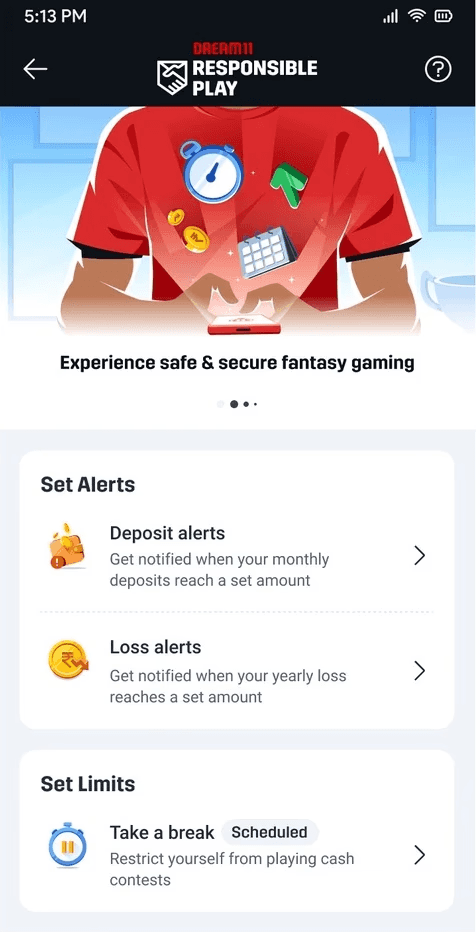
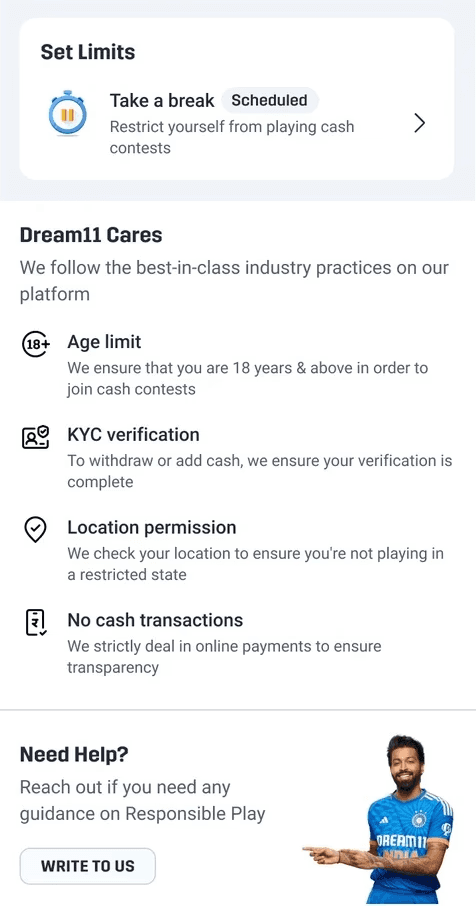
I also worked closely with the illustration team on the hero visuals for this feature, using a structured direction process I had helped develop across the payments team. Rather than handing illustrators a final brief and reviewing the output, I started with Pinterest references and directional intent, then asked the illustration team to bring back initial rough sketches and storyboards. The team aligned on direction at that stage before any final assets were produced. This removed a significant amount of back-and-forth that had previously come from illustrators executing briefs too literally without applying their own visual judgment.
No engagement metrics are reported for Responsible Play. The feature was designed for users who needed to step back from the platform. Measuring its success by adoption or conversion would have been the wrong frame.
This is the work I am most proud of from this period.
When I joined the payments team, every screen in the payment and verification flow was static. Deposit confirmation. Withdrawal success. Verification complete. Each of these moments involved real money and real emotion, and each of them showed the user a flat, motionless screen.
I mapped every payment and verification touchpoint and identified where motion could shift the emotional register of the screen. The starting point was deposit animations tied to the deposit offers launch, where the GST rule had just come into effect and we needed to make the act of depositing feel rewarding rather than costly. I brought cricket into those moments: celebratory animations rooted in Dream11's visual language, built around the sport users were already emotionally invested in. The same language carried through to withdrawal success states and verification completion screens.
Disclaimer :
This reel includes motion work from Dream11 and other projects. Dream11-specific animations cover deposit confirmations, withdrawal success states, and verification completion screens
The vision I had pushed for was more ambitious. A user who wins Rs 50 (approx. $0.60 USD) and a user who wins Rs 1 Crore (approx. $120,000 USD) are having completely different emotional experiences. The previous design gave both the same confetti animation. I had planned to introduce tiered animations where the emotional intensity of the motion scaled with the size of the win: a small, warm moment for modest winnings and a full celebratory sequence for significant ones. The implementation complexity and competing priorities meant that version did not ship. What did ship was a consistent cricket-themed animation language across all deposit and withdrawal states, a significant step up from the static screens that existed before.
None of this was a product requirement. I proposed it, designed it, and directed the animation team through a structured process: reference boards and directional intent first, rough motion sketches from the animation team next, team alignment before final production. This process reduced the back-and-forth that had previously come from animators executing briefs too literally.
All of it shipped. And over time, motion and delight became a baseline expectation for how payment and CX screens at Dream11 should feel.